

How To Calculate Forex Position Size
Comprehensive Guide to Position Size and Leverage
Nota bene:
This is not fiscal advice and I am not a financial advisor. I'chiliad sure there're plenty of licenced professionals in your jurisdiction. Speak to them, not strangers on the cyberspace with Hyman Minsky avatars.
These are just my loosely-held, shittily-formed opinions.
Leveraged trading can exacerbate your losses.

—
Nearly every solar day, whether on Twitter, Telegram, or Discord, I see traders struggling to empathize how to summate their position sizes and generally make sense of leveraged trading.
It tin can exist confusing at first.
In this article, I'll interruption the concepts downward to showtime principles and requite yous a very uncomplicated way to calculate position size, as well as sympathise how and when to employ leverage.
As well, so it's clear from the first: I employ a market stop loss for every single trade, and this commodity carries that assumption throughout.
—
TERMS
Allow's ascertain our terms.
Entry = price at which your order to buy/sell is executed
Upper-case letter = account balance
Position Size = number of contracts/units of an musical instrument you buy or sell eastward.k. BitMEX contracts
Cease Loss = order to shut a losing position to prevent further losses
Risk Amount = Capital you lose on the trade if your stop loss gets triggered e.chiliad. if I want to risk 3% of my Capital on a trade, my Risk Corporeality = Capital x 0.03
Leverage = borrowing Capital from your banker to open bigger positions than you would otherwise be able to
Liquidation = forcible closure of your position
—
POSITION SIZE AND Take a chance Corporeality
Position Size and Take a chance Corporeality are NOT the same.
This is crucially of import to understand, otherwise nothing else will make whatsoever sense.
If my Capital is $1,000 and I am risking 2% per trade, it ways if my Stop Loss gets triggered, my losses will be limited to $20 ($1000 10 0.02 = $20). In other words, I will lose $xx if my Terminate Loss is triggered.
Information technology does NOT mean that my Position Size is $xx.
—
POSITION SIZE CALCULATION ELEMENTS
In order to calculate your Position Size, you need to know your:
I) Hazard Amount
II) Entry
III) Stop Loss
The simplest formula I employ is as follows:
Position Size = Run a risk Corporeality/Distance to Stop Loss
—
POSITION SIZE CALCULATION EXAMPLE
I am trading XBT/USD perpetual swap on BitMEX, and I desire to calculate my Position Size.
I want to short.
Capital letter: $1,000
Gamble Amount: 3% (of $1,000) = $yard 10 0.03 = $30
Entry: 6568
Stop: 6797.2
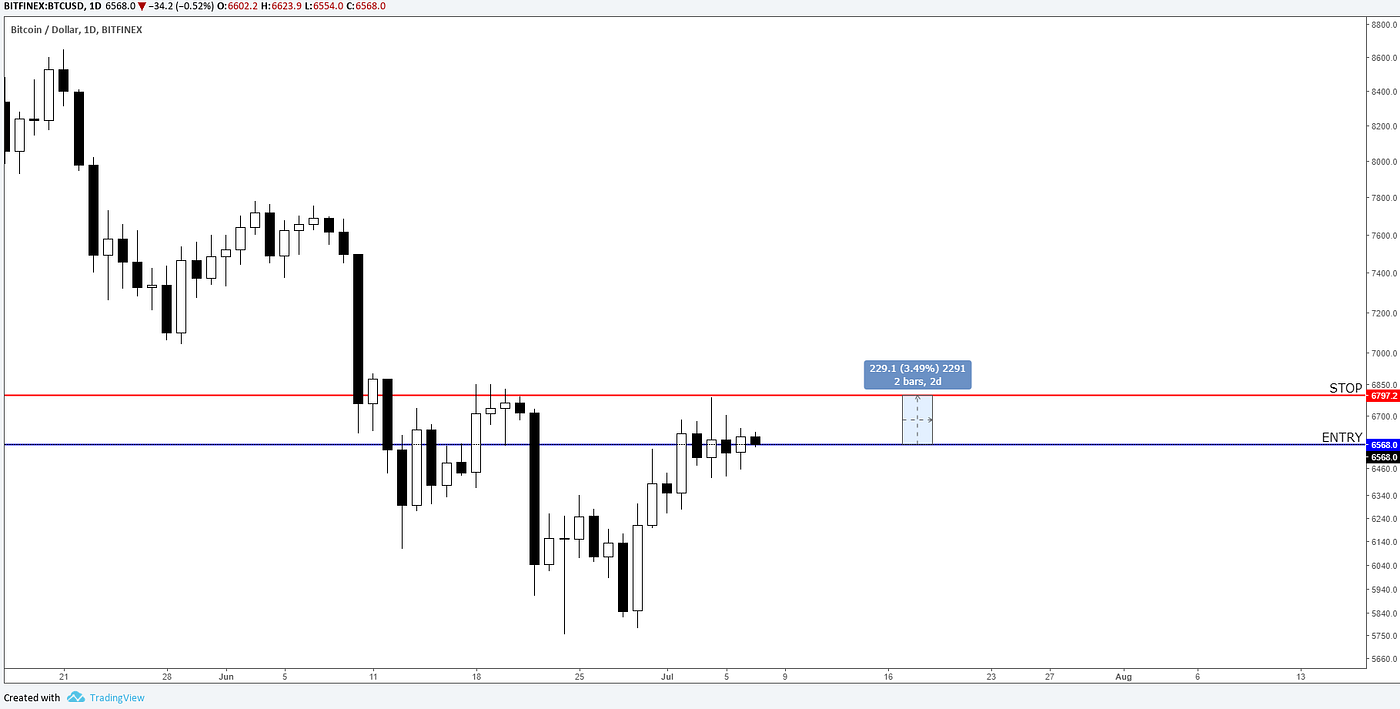
In lodge to calculate the Distance to Terminate Loss part of the equation, I simply use the TradingView measuring tool, and then convert the percentage into a decimal.
To convert a percentage into decimal form, yous merely divide the percentage by 100 (i.due east. movement the decimal signal two figures to the left) eastward.g. 3.49% is 0.0349 when expressed as a decimal.
If your maths is truly horrendous, you can even use a percentage to decimal conversion tool.
Allow's return to our example.
Position Size = Gamble Amount/Distance to Stop
Position Size = ($1000 x 0.03)/0.0349
Position Size = -860 contracts (I rounded up from 859.598854)
You can too backtest to run into if your maths checks out.
860 (Position Size) x 0.0349 (Distance to End Loss) = thirty (Risk Amount) if price reaches my Stop Loss.
Checks out.
—
TIGHT Stop
The expression of having a "tight stop" should now make a lot more sense.
The closer your End Loss is to your entry, the bigger Position Size you lot tin can merchandise while keeping your Risk Amount the same.
It sounds counterinuitive, so let's look at the numbers.
Suppose we have two traders, Tim and Wade, trading XBT/USD perpetual swap on BitMEX. They have the same Capital, Chance Corporeality, and Entry. The only divergence is in their Stop Loss placement.
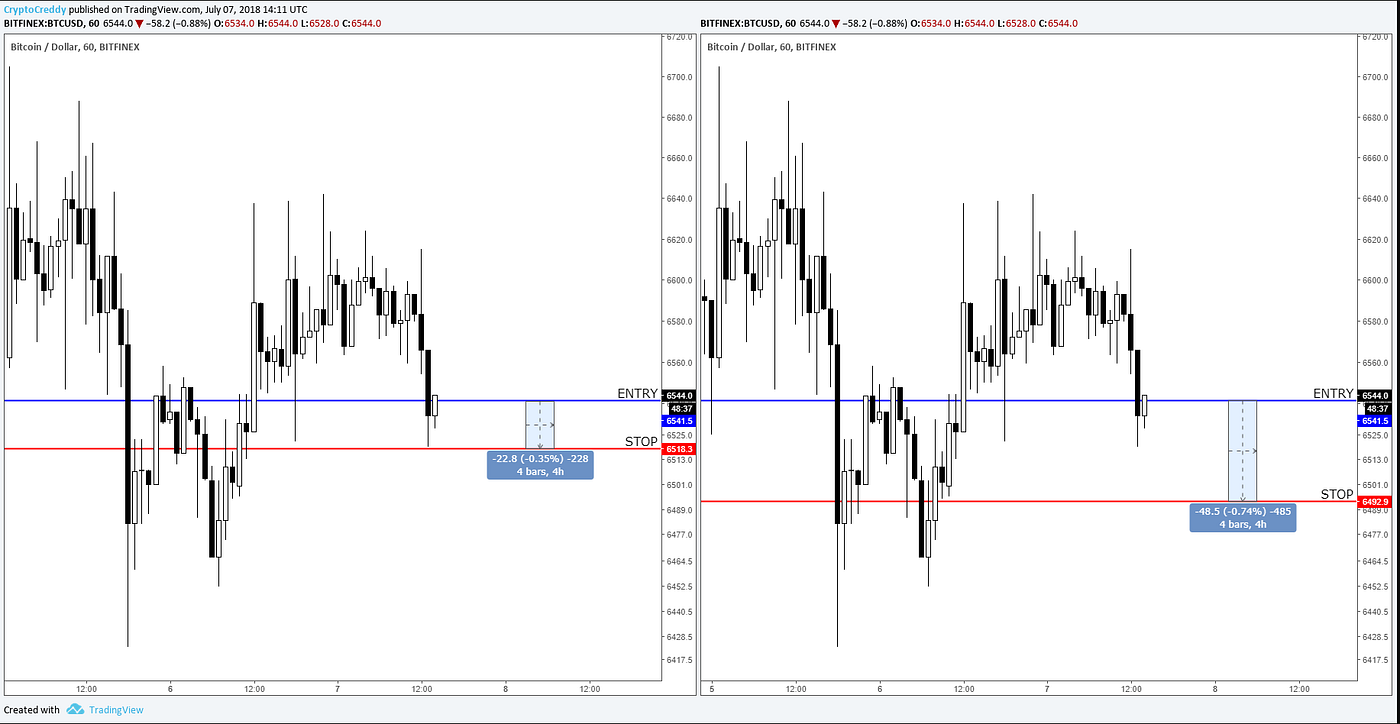
Trader 1: Tight Stop Tim
Capital: $v,000
Gamble Amount: iii% (of $five,000) = $5000 x 0.03 = $150
Entry: 6541.5
Stop Loss: 6518.iii
Distance to Terminate Loss: 0.35%
Position Size = Risk Amount/Altitude to Stop Loss
Tim's Position Size = 150/0.0035 = +42,857 contracts
Trader 2: Wide Stop Wade
Capital: $5,000
Adventure: three% (of $5,000) = $5000 x 0.03 = $150
Entry: 6541.v
End Loss: 6492.nine
Distance to Finish Loss: 0.74%
Position Size = Risk Corporeality/Distance to Terminate Loss
Wade's Position Size = 150/0.0074 = +twenty,270 contracts
Thus, there is a balancing act. A tighter Terminate Loss gives you bigger Position Size, simply you also have less breathing room. A wider Cease Loss gives you lot smaller Position Size, just you lot have more breathing room.
End Loss placement should never be arbitrary.
If you want to know more nigh Stop Loss placement, I strongly recommend check out my article.
—
LEVERAGE I
If you lot're going to take away one thing from this commodity, it should be that Leverage does NOT change the Position Size calculation.
Read that again.
Leverage does Not change the Position Size calculation.
Instead, Leverage serves two primary purposes (among others):
- Reduces your counterparty take chances by assuasive you to trade larger Position Size without having all of your Uppercase with your broker
- Allows you lot to trade with a Position Size greater than your Capital when so required
Consider the following case of someone trading XBT/USD perpetual swap on BitMEX.
Uppercase: $10,000
Risk Amount: four% (of $x,000) = $x,000 x 0.04 = $400
Entry: 6565.2
Stop Loss: 6519
Distance to Finish Loss: 0.70%

Position Size = Risk Amount/Distance to Cease Loss
Position Size = 400/0.007 = 57,143 contracts
Look, 57,143 contracts? But the trader'due south Capital is simply 10,000. How is that discrepancy reconciled?
Leverage.
Leverage allows the trader to open that position, which is greater than his Uppercase, using borrowed funds from the broker.
I reiterate: the fact that the Position Size in the example will exist 57,143 contracts remains unaffected by Leverage. That number is stock-still.
Opting for higher Leverage simply means that the trader wants to put up a smaller amount of Capital to open that same Position Size of 57,143.
Opting for lower Leverage simply means that the trader wants to put upwardly a greater amount of Upper-case letter to open that same Position Size of 57,143.
Moving the Leverage slider will Non alter the number of contracts (your Position Size) — it volition merely affect how much of your Uppercase you utilise to open up that same position.
However, this does NOT mean yous can use maximum Leverage simply considering your Position Size is unaffected.
You need to ensure that your Stop Loss kicks in before your Liquidation. Using the Liquidation Price estimator, you tin can summate your Liquidation before opening a position; thus allowing you to ensure that your Stop Loss comes first.
I cover this in more detail in LEVERAGE III.
—
LEVERAGE II
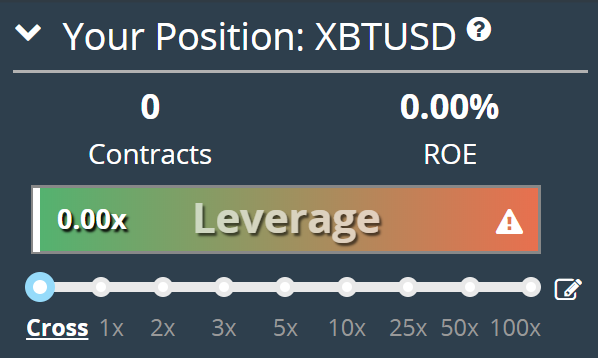
Leverage usually comes in two flavours: Isolated Margin and Cantankerous Margin.
Isolated Margin
Liquidation liability is limited to the original margin posted i.e. broker will NOT use your remaining Upper-case letter to continue the position open.
You lot can besides (overload permitting) increase/decrease your Leverage on the go.
This is usually the preferred method for traders taking one-off speculative directional trades.
Cross Margin
Broker can use all of your Majuscule to avert Liquidation, but Liquidation means your total Capital goes to 0.
This is usually the preferred method for traders with multiple concurrent positions.
I don't recommend using Cross Margin if you're new to leveraged trading.
—
LEVERAGE Three
Let's put it all together.
How does Leverage bear on the Position Size calculation?
The short answer is that information technology doesn't, as long as your market place Finish Loss is triggered before your Liquidation
The adjacent logical question is "How practise I know what my Liquidation cost is before I have opened a position?"
The answer is that BitMEX (and virtually other exchanges and brokers) provides a figurer that does all the work for y'all.
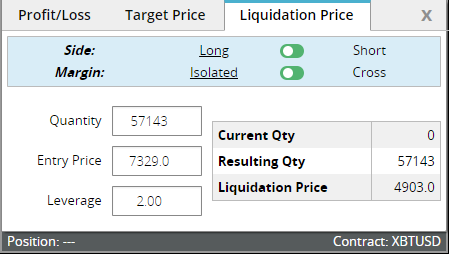
Information technology is imperative that you i) calculate your Liquidation Cost before opening a position ii) ensure that your market Finish Loss kicks in before you get Liquidated.
Your Position Size is far more of import than the Leverage you employ. That is why it'southward pointless to ask what Leverage is "prophylactic" or what Leverage some other trader is using, because you take no thought of their other run a risk-related parameters. That information is incomplete and therefore largely useless.
I reiterate: Leverage does Not change your Position Size
If I am long 10,000 contracts at X2 Leverage that does Not hateful I am long 20,000 contracts.
The only style you lot can make more is by risking more than i.east. larger Position Sizes existence key, Not ramping upward the leverage.
The simplest way to put it: Position Size is the well-nigh of import thing, and Leverage simply allows i) your Position Size to be greater than your Capital when so required ii) trade your usual size without keeping all of your Capital with your banker
—
CHECKLIST
Here'southward how I apply all of this when entering a merchandise.
I volition supply some fictitious answers and then that the format makes sense.
Assume this is for a long position on XBT/USD perpetual swap on BitMEX.
- What is my Capital? $1,000.
- What % of my Capital practise I want to gamble? 3%.
- What, therefore, is my Risk Amount? $1,000 x 0.03 = $30
- What is my Entry? 6500
- What is my Stop Loss? 6400
- What is the distance to my Cease Loss from my Entry? ane.54%
- What is my Position Size? Position Size = Adventure Corporeality/Altitude to Stop = thirty/0.0154 = +ane,948 contracts
- Using the BitMEX Liquidation Price calculator, volition my market place Stop Loss trigger (some mode) before my Liquidation? Answer must exist aye.
—
CONCLUSION
Here are some points that are hopefully clear:
- Position Size is NOT the same equally Run a risk Amount, but information technology is derived from your Take a chance
- You only neeed to know your Risk Amount, Entry, and Cease Loss to calculate your Position Size
- Position Size = Risk Amount/Altitude to Finish Loss
- The closer your Finish Loss to your Entry, the bigger your Position Size (and the changed is truthful also)
- Leverage does Not affect your Position Size and Leverage does NOT alter the Position Size adding equation — the only way to brand more coin is by trading bigger Position Sizes (and the added gamble that comes with doing so), non past moving a Leverage slider
- Apply the Liquidation Price calculator prior to opening a position to ensure that your Finish Loss kicks in before you go Liquidated
- Asking/caring about what Leverage other traders use is pointless without knowing more information — it'southward mostly used as a marketing gimmick
—
Sentry my video on Risk Management
Read my commodity on Stop Losses
Follow me on Twitter
Jump in to my Telegram channel
Learn technical assay for free
Subscribe to my YouTube
Ship me a $BTC tip: 3Me8nKU7JfSXGG2WfT5VXbfH2vMs1xpcS1

Source: https://medium.com/@cryptocreddy/comprehensive-guide-to-position-size-and-leverage-2e27764ce9e0
Posted by: gonzalezwhences.blogspot.com
0 Response to "How To Calculate Forex Position Size"
Post a Comment